
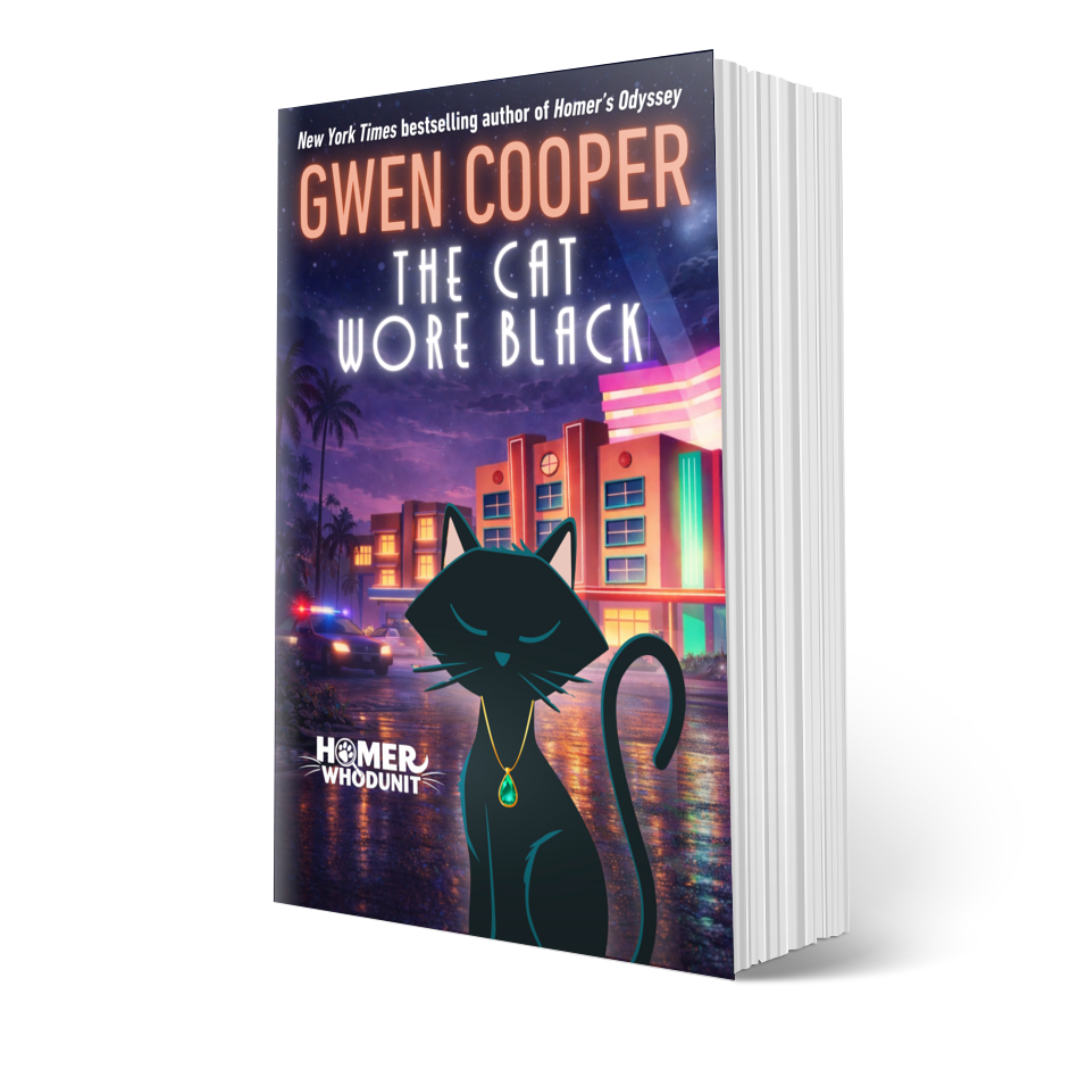
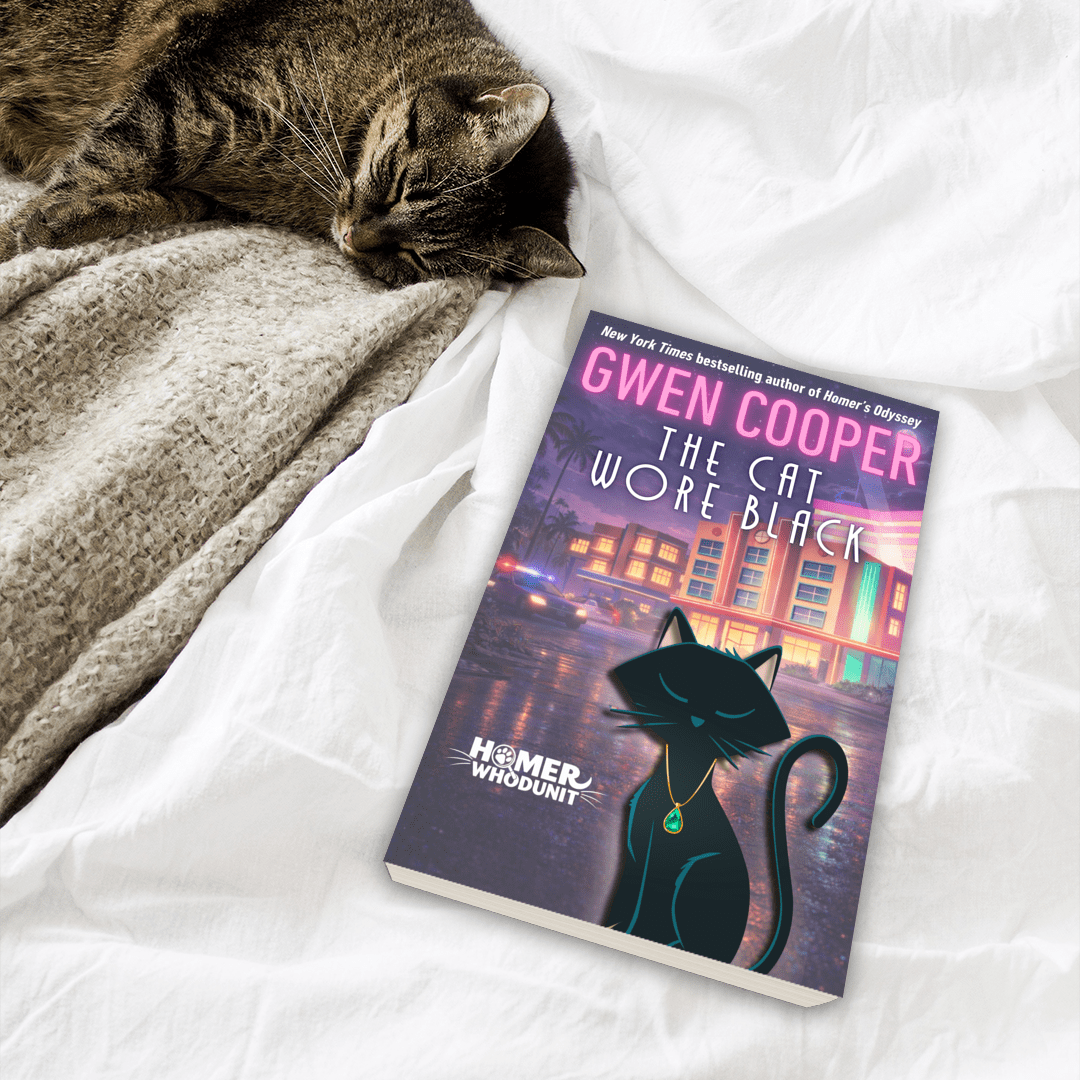
THE CAT WORE BLACK - PAPERBACK PRE-ORDER!
“Gwen Cooper shines her light on the territory that defines the human/animal bond. That, in itself, is a reason to stand up and cheer.”
COMING NOVEMBER 24th, 2026!
Delivery Information
E-books and Audiobooks: Delivered via email by BookFunnel immediately after purchase. Includes free, dedicated tech support!
Paperbacks: Delivered by our partner. Please allow 10 days for delivery.
COMING NOVEMBER 24th, 2026!
Join Homer and the gang on sunny Miami Beach for the second Homer Whodunit cozy mystery!
It's autumn 1998 in glamorous Coacoochee — just ten minutes up A1A from South Beach — and tourist season is about to kick off with the social event of the year: an exclusive fashion show and after-party aboard the yacht of movie star Claudia Campos. Champagne flows, flashbulbs pop, and a priceless emerald necklace steals the spotlight, draped around the neck of bookstore manager Rachel Baum's green-eyed cat, Vashti. Then the lights go out. When they come back on, the emerald has vanished. The event photographer lies dead. And everyone on the yacht is a suspect.
Rachel didn't plan to get involved. But the dead man was last seen arguing with someone she knows, the missing emerald belongs to one of her closest friends, and the deeper she digs, the more Rachel realizes nearly everyone at that party was keeping secrets long before the lights went out. Meanwhile, Rachel's three cats — led by her blind cat, Homer — have launched their own investigation, unaware that the closer they get to the truth, the more danger all four of them are in.
Sample Chapter
CHAPTER ONE
“I've got your pistol right here.”
Brock Winfield made an exaggerated finger gun with his right hand, drawing his eyebrows together in a way he was positive made him look rakish and slyly seductive. This was his only line in the entire production, and he planned to make the most of it.
“Cut!” Tommy Duvall shouted. The piano accompaniment lurched to a halt mid-chord, as did the whirling chorus of background dancers onstage. It was impossible to identify them as the 1960s teenagers they portrayed, given their disparate ages and unmistakably 1998 streetwear. (Costume fittings wouldn’t begin for another week.) Rachel Baum, seated next to Tommy, sighed in mild dismay. “Reproduction” was her favorite number in Grease 2. She’d specifically timed her arrival to coincide with it, Tommy having assured her she’d be able to see it performed all the way through at tonight’s rehearsal if she turned up right after closing shop for the day. This was the third time, however, that he’d halted the actors mid-song.
“Remember, darling,” he told Brock, “you're talking about a pistil—as in, a plant's reproductive organ. Not a pistol, like a gun. And keep in mind you're playing a high school student. You want to look flirty and rambunctious, and not quite so—” Tommy thought for a moment. “Constipated,” he finally said.
Tommy and Rachel were sitting in the precise center of orchestra row L in the Colonnade Theatre on Hibiscus Road. From one floor above them, in the theater’s balcony, came the faint but distinct sound of a feline snicker. A plump, white-chested gray tabby with yellow-green eyes peeped over the balcony’s railing, trying to watch the onstage action without being spotted herself.
“And that,” she observed, her voice heavy with irony, “was the best line reading he’s managed so far.” Scarlett (for this was the gray tabby’s name) hadn’t spent much time in the theater over the course of her three years—all but the first month of which she’d lived with Rachel. But having passed much of her time lately sneaking in and out of the Colonnade to watch Grease 2 rehearsals, she was starting to pick up the lingo.
“Shhhh,” admonished the slender black cat hiding alongside her. His name was Homer, and at just over one year old he was the youngest of Rachel’s three cats. Homer had been completely blind since birth, and his preternaturally sharp hearing had already gauged how the Colonnade’s acoustics were likely to amplify their voices. Scarlett’s volume, which would have been low in most settings, was a shade too loud for a theater. “Rachel can hear you.”
As if in confirmation, Homer’s whiskers caught the shift in air currents as Rachel turned and looked up. “Did I hear a cat?” she asked Tommy. For an instant, she could have sworn she’d heard Scarlett’s low-pitched mrowr of disapproval. Then she shook her head, the brown-black curls she could never quite tame in Miami Beach’s fierce humidity bouncing in tandem. “I must be losing my mind. What’s left of it,” she added, not entirely kidding. October—only a few weeks in the rearview mirror—had been challenging, to say the least.
“That’s what I love about these old theaters.” Tommy gazed with affection at the lovingly restored woodwork and molded plaster that gave the Colonnade, originally built in the 1950s, so much of its charm. “You can still hear whispers from all the people and productions that’ve come and gone over the years.”
The Colonnade was Coacoochee’s most-beloved cultural institution and one of the crown jewels of Hibiscus Road—a sun-drenched, Nautical Deco/Miami Modern (or “MiMo”) promenade that ran twelve blocks, east to west, through the heart of town, from the Oceanside Drive boardwalk at one end all the way out to the low-rise apartments of Jacaranda Drive at the other. Title Wave, the café bookshop Rachel had been running for just over seven months, was also located on Hibiscus Road, just four blocks down from the Colonnade. It was infinitely easier for her and Tommy to drop in on each other now than it had been when he’d spent his workdays in the offices of glossy Palm magazine, over at the far end of Allamanda Avenue.
Nina Thompson, the Colonnade Theatre’s owner and tech manager, was perched at the moment atop a ladder that had been set up downstage left, her tall, lanky frame invisible from the shoulders up as she attacked a loose lighting fixture with a screwdriver. The ladder wobbled slightly, but Nina maintained the easy balance of someone who’d spent half her life climbing up and down ladders.
Now in her mid-thirties, Nina had arrived in Coacoochee some six or seven years earlier, when it was still more forgotten backwater than high-glam destination. She’d purchased the Colonnade practically for pennies and spent the next several years restoring it to its former glory while Coacoochee metamorphosed around her. Just ten minutes up A1A from South Beach, Coacoochee was a sunny barrier island that had spent decades as an afterthought, an Art Deco beauty that had fallen from the grace of its midcentury heyday and spent the Seventies and Eighties fading, Norma Desmond-like, into an opulent, seedy obscurity.
Today, Coacoochee was the East Coast’s most gossiped-about beach community after East Hampton and Martha’s Vineyard.
“Isn’t she a busy bee.” Scarlett’s tone was laced with disapproval as she observed Nina atop the ladder; she disdained work (a purely human invention if ever there was one) on general principle. Homer, meantime, tensed as he heard Tommy rise from his seat downstairs. Sometimes Tommy liked to come up to the balcony to see what the staging looked like from above.
But Tommy merely stretched for a long moment before settling himself comfortably once again in his plush maroon seat, elbows resting on gleaming wooden armrests as he jotted notes onto a pad propped in his lap. Suddenly the stage door slammed open with a bang, admitting a shaft of sunlight tinged marmalade in the approaching sunset. Homer heard Tommy swear under his breath as his pen startled forward to leave a tiny black smudge on his otherwise impeccably clean, cream-colored linen slacks.
In walked three men carrying armfuls of clear plastic bags containing beehive wigs. It took Rachel a beat to realize they were performers from the Pink Flamingo cabaret over on Thirteenth Street, between Allamanda and Rollins Avenues. In their regular street clothes, they barely resembled the outrageously costumed performers who drew raucous bachelorette parties from as far away as Fort Lauderdale and Boca.
Up in the balcony, Homer's nose worked furiously, cataloging hairsprays and perfumes and the faintest hint of cigarette smoke meticulously shampooed from the hair of the wigs with fruit-scented cleansers. The gust of air from Hibiscus Road brought the smell of salt from the ocean, of restaurant kitchens just beginning to simmer garlic and seafood for evening diners, of coconut-scented sunscreens worn earlier in the day by tourists on their way to the beach, of night-blooming jasmine and strong Cuban coffee and foil-wrapped cigars from the tobacconist’s next door.
“You didn’t tell me I’d have to lend them Charlene!” Homer could hear one of the men stage-whisper angrily as the three walked in. “Charlene” was, presumably, the auburn bouffant cradled in his arms.
“Don’t be such a diva,” replied another, the tallest of the three. “It’s only two performances.” Then, coming within earshot of Tommy, he raised his voice and said, “Did you take care of the humidity problem in the dressing rooms?”
“I'm working on it,” Tommy replied.
“You said that on Tuesday.”
“I'm still working on it.” Tilting his head sideways toward Rachel’s, in a lower key, Tommy added, “All of South Florida is humid. What am I supposed to do about that?” His tone was plaintive in a way that instantly won her to his side, although privately Rachel sympathized with anyone worried about the frizzing effects of moisture on hair.
While still known around town as “Mr. Nightlife,” it had been nearly a month since Tommy had given up his high-profile position as the weekly nightlife and gossip columnist for Palm, unsure what he wanted to do next with his life but determined to make it meaningful. A stage adaptation of the movie Grease 2 was a passion project he’d secretly been dreaming of for years. “It’s hard to believe no one’s ever tried it,” he’d confided in Rachel, his Savannah accent thickening slightly in the way it tended to when he was genuinely perplexed.
As it happened, within only a week of Tommy’s having left his position at Palm, a pre-paid, one-month residency at the Colonnade had unexpectedly become available. A newly minted “dot-com” millionaire (it seemed everyone in Coacoochee was buzzing about the information superhighway these days) had originally booked the theater on behalf of his model-slash-actress girlfriend, who planned to perform the one-woman play Eleanor as a showcase for her talents. Upon reading the play, however (“Eleanor ROOSEVELT?? And she’s HOW old?!”), the model-slash-actress had reconsidered, then wisely demurred.
The dot-com millionaire chose to regard the entire foray as a charitable donation gone only slightly awry—a perspective endorsed by his accountant—and had allowed the Colonnade to keep the deposit he’d already paid. Tommy heard about the debacle through the grapevine and, although he’d never planned to try his hand at directing a community-theater production, couldn’t resist putting in a few discreet inquiries. A longtime friend at Coacoochee’s Department of Tourism had come through with a miniscule operating budget, and the rest was being accomplished with amateur actors of all ages (plus one or two waiters with aspirations), a bevy of volunteer set designers, and the invaluable services of Nina Thompson herself.
“What’s happening now?” Homer asked Scarlett, in a pointedly lower tone than the one she’d been using.
Scarlett watched as Tommy strolled toward the stage to speak with the three wig bearers, his athletic build taller than the tallest of them, yet somehow still dwarfed by them. The actors, meantime, had begun to gravitate in their general direction. “I think they’re going to try on the wigs.”
“Vashti will be sorry she missed this,” Homer observed.
And Scarlett—reckoning that this was probably true, while simultaneously remembering why Vashti wasn’t with them at the moment—rolled her eyes and said nothing.
***
At that exact moment, in a small jewelry shop on quaint Hispañola Way just off Hibiscus Road, under the impassive gaze of an armed security guard, Vashti was doing her level best to hold still.
This was harder than it sounded, in part because Soleil Jewelers was full of the kind of small, glinting objects that set off every one of Vashti’s predatory instincts. It was also full of mirrored surfaces—although, somewhat maddeningly, Vashti was angled in such a way that she couldn’t see her own reflection. Only that of Molly Malloy, owner of Soleil Jewelers, as she stood behind Vashti, her slender white fingers making the miniscule adjustments at the back of Vashti’s neck that produced an almost irresistible urge to turn and investigate.
But Vashti had spent enough time in Molly’s shop by now, being fitted for the necklace she would wear tomorrow night, to know that holding still meant being released sooner. So she didn’t budge and didn’t flinch, not even when a minute, nearly invisible metal burr that projected from the underside of the clasp—where a positioning wheel had failed to smooth the edge completely—caught at a strand of her fur and tugged.
It bothered Molly, too, every time her finger found it. Vashti could see in the mirror the way Molly’s face—which normally wore a big, beaming smile—now creased into a frown. The piece had been altered in a rush, and it showed in the details.
Aside from the red flame of her hair, Molly’s coloring and Vashti’s weren’t dissimilar. (In New York, where she was from originally, Molly could disappear into a crowd if she wanted to; on Miami Beach, her fair-skinned Irish beauty was downright exotic and impossible to overlook.) Two pink spots bloomed in Molly’s cheeks, vivid against the milk-white of her skin, as she contemplated the clasp’s defect. Once the clasp was closed, however, and the emerald had settled onto the precise center of Vashti’s chest, a satisfied gleam appeared in both sets of green eyes.
Molly had been dreaming of this necklace since she was a jeweler’s apprentice in Manhattan, and had spent the better part of three years persuading the gem dealer to hold the stone for her while she scraped the money together. Looking at it now—the fifteen-carat emerald cradled in a filigree of gold vines so fine they seemed almost to be growing around the stone—it was hard to believe that tomorrow night, at last, the whole world would finally see it.
Albeit around the neck of a cat.
What do you think, Miss Vashti?” Molly asked, and Vashti found herself charmed—as humans also usually were—by the way Molly’s ordinary speaking voice bubbled up like laughter. She angled the cushioned stool upon which Vashti rested so Vashti could finally see herself. “I think you’re going to steal the show.”
Even as the two of them gazed at the emerald’s reflection, in the little jewelry shop on Hispañola Way, work crews out on Rollins were trading hard hats for baseball caps as they headed for Thursday-night happy hour, having spent all day transforming the storied Lucerne Hotel’s pool area ahead of tomorrow night’s fashion show. (Among the most coveted perks Tommy had ever attained as Mr. Nightlife were complimentary poolside chaises for himself and Rachel at the Lucerne, one Saturday during the off-Season.) The world-infamous bungalows had temporarily been swapped for rows of folding chairs, and a long white runway that ran three-quarters of the way from the deep end to the shallow had been extended into the pool itself.
Tomorrow night—as spotlights shone and flashbulbs popped—a select crowd of Coacoochee’s best and brightest would gather to kick off the official beginning of this year’s Season.
And Vashti would be among them.
The whole point of today’s visit was to make sure the necklace sat properly against her fur. It had been designed for a human throat, of course—not a cat’s—and resizing it had required hours of careful work on Molly’s part. Rachel had dropped Vashti off on her way to Tommy’s rehearsal at the Colonnade. Molly and Vashti had fallen into a comfortable rhythm since Vashti had started coming for fittings, and Vashti was surprisingly complacent in her care. (Surprising from Rachel’s perspective—because had it been Homer or Scarlett instead of Vashti, nothing could have induced them to sit still while Molly handled them.)
Rachel found it easier not to be there while Molly worked. This wasn’t because she was bored (far from it!) or because she didn’t like Molly. It was simply because everything about this entire episode in her and Vashti’s joint lives together—including the astronomical value of the stone hanging from her own cat’s neck!— made Rachel dizzy with nerves.
It was Sabine Ackermann—former runway model and founder of ModelHaus Miami—who had first seen Vashti’s potential. ModelHaus, headquartered in a lavish Oceanside Drive penthouse, had built its reputation on turning unknown faces from São Paulo and Bratislava into ten-grand-a-day household names. Sabine had been coming into Title Wave for years, mostly to buy art books or the occasional coffee-table volume on fashion history that Rachel had learned to keep in stock for her, and she’d been struck by Vashti from the first. “If you would ever consider hiring her out for a fashion shoot,” Sabine had told Rachel in her throaty voice with its thick German accent, “I would be interested in talking to you.”
Rachel typically smiled or chuckled when Sabine said things like this, not quite taking her seriously. But then one day Sabine had called about a lifestyle shoot for a South Beach magazine. Sunny and casual, she’d said. Merely a few hours on a poolside terrace alongside two experienced models, for a high-end handbag shoot that needed only a luxurious-looking pet to cement the air of moneyed ease the client had in mind. Vashti—with her long, luminous white fur, the extravagant plume of her tail, and her exquisite pearl-pink nose—fit the bill precisely.
“Moneyed ease” was about as far as one could get from a description of Rachel’s own life. Only last month, Scarlett had sprained her leg leaping from the cash register, her three pounds of what the vet called “excess weight” making such maneuvers tricky—and also expensive, as it turned out. The fee Sabine named wouldn’t exactly allow Rachel to retire, but it would certainly help smooth out the dent Scarlett’s X-rays had made in Rachel’s savings.
Homer had been the only one of the three cats able to hear Sabine’s end of the phone conversation. Sensing the quizzical glances the other two threw his way, Homer told them, “Sabine Ackermann’s trying to hire Vashti as a model again. This time Rachel’s going to say yes.”
A small thrill had run through Vashti, who’d known instantly that a moment she hadn’t even realized she’d been waiting for had finally arrived.
“We should get you into your carrier. Rachel will be here to pick you up soon.” Molly unclasped the necklace from Vashti’s neck and placed it carefully into its custom velvet case, then crossed with her light, quick step to the safe in the back of the store, which weighed in at over two thousand pounds and had been cemented to the floor. “Let me just put this away. It’s worth more than your life and mine put together!”
Vashti loathed being forced into the sky-blue carrier, even when she knew she wasn’t going to the vet’s office. Still, she didn’t struggle with Molly the way she would have with Rachel at home. Some things—moments, for example, when one might not appear as gracious or graceful as one might wish to appear—should only be seen by family.
And besides: Vashti didn’t want to get a reputation for being difficult to work with.
***
It wasn’t as if the intervening weeks since that first photo shoot had made Vashti a feline supermodel or anything. Still, her recent appearance in the TV spot for a local luxury auto dealership had led more than one Title Wave customer to exclaim: “That looks just like the cat from the Bentley Boca Raton commercial!”
Vashti had resolved early on not to betray any obvious awareness of the additional fuss. She was far too intelligent to let Rachel discover just how much she understood of what the humans around her talked about. (While the cats were perfectly capable of understanding every word people said, Rachel—like all humans—heard only meows when her cats “spoke” to her.) Still, Rachel had noted the quick and dainty, yet utterly confident, step with which Vashti now entered rooms. As if, Rachel liked to say, a late-night talk show host had just introduced her. (“Ladies and gentlemen, it’s VASHTI!”)
Homer, for his part, had no intuitive understanding of what physical beauty was, or why Vashti’s or anybody else’s mattered so much. Despite the truly astounding feats he was able to accomplish with his other senses (he could smell the difference between a sealed can of salmon and a sealed can of tomato paste, and could pick out Rachel’s footfall from among the throngs on Hibiscus Road while she was still blocks away), Homer had no innate grasp of anything related to vision. He was terrible at hiding and even worse at sneaking up on anybody, despite his ability to walk so silently that even he would have been hard pressed to hear himself.
Scarlett understood the whole thing better than Homer did, but couldn’t have imagined anything less likely to excite her envy. There was exactly one human whose presence Scarlett could tolerate for more than five consecutive minutes, and that human was Rachel. The only reason humans other than Rachel even needed to exist was because Rachel, for utterly baffling reasons, couldn’t seem to be happy devoting her time and attention exclusively to the three perfect cats with which she’d been blessed. (Well—one perfect cat, one tolerable cat, and Homer; Scarlett still wasn’t entirely sure why Rachel was so attached to him.)
If what made Vashti happy was these photo shoots of hers—where she was touched and looked at and talked to by humans for hours on end—she could have them, as far as Scarlett was concerned. Besides, it wasn’t as if the rest of their day-to-day lives outside of Vashti’s modeling career had changed all that much.
But that was before Vashti had gotten booked—along with that ridiculous necklace—to be the surprise grand finale at the big fashion show tomorrow night. It would be the formal kickoff for this year’s tourist season, which ran from November to April and was referred to simply as Season by locals. Even Scarlett had to admit that it was kind of a big deal. It seemed like the whole town was trying to guess exactly what the big, over-the-top finale was going to be. Title Wave’s local patrons had been buzzing with questions, guesses, and wildly inaccurate rumors for what felt like ages.
Only a carefully selected handful of people knew the answer to this question. Sabine Ackermann was one of them, of course. She’d cast all the show’s models, down to the male models who would bear the elaborate, Egyptian-themed litter upon which the show’s closing model would be carried down the runway.
But the model wouldn’t be alone on her litter. At her side—adorned with a magnificent emerald set in gold and diamonds—would be a cat. And not just any cat. A cat who looked, down to the last strand of her fur, like exactly the kind of cat who would have been worshipped as a goddess in ancient times. A cat whose eyes were as luminous and green as the stunning fifteen-carat emerald itself.
Rachel’s nerves were shot as the fashion show grew closer. What if Vashti embarrassed both of them by hoisting her hind leg and cleaning her privates in public (as cats were wont to do) in full view of Coacoochee’s most sought-after social elites? What if all the commotion and noise set Vashti off in some way, and she clawed a model’s face to ribbons? What if Vashti lost the emerald necklace (!!!) and Rachel had to spend the rest of her life working to pay off the debt until she’d been worn down to an elderly gray nub, like the unfortunate woman in that Guy de Maupassant story?
(It had been murder keeping the whole thing from Tommy, and even harder being unable to confide her worries to him so he could calm her down. But Rachel had been sworn to secrecy, and Tommy had spent five years as one of Coacoochee’s premier gossip columnists.)
A commotion onstage brought Rachel back to the present. The actors had mostly abandoned any pretense of rehearsing and were now clustered around the wig bags, holding beehives and flips up to their heads and mugging for each other. One of the Pink Flamingo performers was showing a teenage girl how to pin a bouffant so it wouldn't slide, while another had produced a Polaroid camera and was attempting to organize the full cast and crew into a group shot.
“Everybody in! Come on, people—this is for posterity!”
There was the usual cheerful chaos of a group photo being assembled—people jostling for position, a brief argument about whether the wigs should be on or off. Rachel watched with amusement as Brock elbowed his way past Tommy toward the center of the group, chin lifted at an angle he'd clearly spent hours practicing in front of his home mirror.
Nina, who’d descended from her ladder at some point during the wig hijinks, had been standing near the edge of the stage. As the photographer began waving people into the frame, Rachel saw her take a small, almost imperceptible step backward. Not away from the group entirely, which would have been conspicuous, but just enough to place herself behind a tall actor's shoulder. When the photographer called out “one more!” and people shifted and resettled, Nina adjusted again, a subtle half-turn that angled her face away from the lens. It was so smoothly done that Rachel might not have noticed at all if she hadn't happened to be looking directly at her.
Camera shy, Rachel thought. She could relate. It seemed as if you were never more than five feet from a camera in Coacoochee. And sometimes—particularly when she’d been doing the kind of grunt work in the bookstore that Nina had just been doing atop her ladder—the very last thing Rachel wanted was to have her sweaty face and frizzy hair memorialized for all time.
Although Tommy hadn’t called out an official “take five!,” by general unspoken agreement a short break seemed to follow the group photo. Rachel watched as Brock cornered one of the waiters-with-aspirations, clutching the battered copy of his self-published novel, Borrowed Glory, that he carried with him everywhere. It was a great groaning doorstopper of a book, and Rachel herself hadn’t been able to make it past the first two chapters when Brock had asked her to consider stocking it at Title Wave.
Her refusal hadn’t gone over well, the sting of rejection sharpened by the fact that Brock Winfield had been Title Wave’s manager before Rachel, who’d been hired to replace him. That he’d consistently shown up late to work—and spent the bulk of his hours at Title Wave writing Borrowed Glory rather than actually running the store—hadn’t tempered the deep resentment he’d felt toward Rachel as a result, and the two of them had a rocky history. But the détente they’d reached back in October had proven surprisingly durable.
For the moment.
Tommy came to the rescue of the cornered waiter and pulled Brock discreetly aside. With the elaborate patience of a man who has explained this particular thing several times before, and is making peace with having to explain it yet again, he once more reviewed for Brock the taxonomic distinction between flowering plants and small firearms.
“I know what a pistil is,” Brock muttered, eyes on the floor, to nobody in particular.
Scarlett and Brock had their own rocky history—and had never reached détente of any kind, durable or otherwise. Scarlett listened to Tommy and Brock now with malicious glee. “How could such a brilliant writer”—her tone was thick with sarcasm—“have so much trouble remembering one simple word?” She and Homer—who disliked Brock less than Scarlett did, but not by much—chortled helplessly for a moment, until Scarlett’s laughter culminated in a sneeze that caused Rachel to turn her head sharply in the direction of the balcony. Scarlett and Homer ducked down before she was able to catch a glimpse of them.
“I should be getting back.” Rachel rose and glanced at her watch, brushing her cheek against Tommy’s as he returned to her side.
“Give the beauty queen a smooch for me.” Although not one to pay much attention to cats in general, Tommy had bonded with Vashti almost instantly. Tommy thought Vashti was the most glamorous non-human creature he’d ever seen, and Vashti thought Tommy was probably right.
“Places everyone!” Tommy turned now to face the stage. “I want to get all the way through this number at least once before we wrap for the night.”
The piano music resumed as Rachel gathered her bag and headed up the aisle toward the lobby. Before she pushed through the heavy doors, Rachel turned back to watch Brock onstage as he declared, his voice carrying with theatrical projection across the empty rows: “I've got your pistol right here.” Then he made an exaggerated finger gun with his thumb and forefinger, exactly as he had earlier.
“CUT!” Tommy roared, and Rachel smothered a laugh.
Up in the balcony, Homer's ears tracked Rachel's footsteps as they crossed the lobby and faded through the theater's front doors onto Hibiscus Road. “We should leave now, so we can beat Rachel home,” he said to Scarlett. Nothing was likelier to curtail their freedom than Rachel’s discovering just how much freedom her three cats actually enjoyed.
Scarlett sighed. Home had been unbearable of late—mostly because of all the brouhaha surrounding Vashti—but Homer was right. It was time to go back.
The two cats crept through the balcony and down a rarely used service staircase, which connected with a narrow maintenance corridor. The corridor’s propped-open window led out into the alley behind the theater. Homer walked confidently ahead of Scarlett, his whiskers brushing the wall as he navigated by touch and airflow, moving with the silent, sure-footed grace that always seemed so improbable in a cat who couldn't see where he was going. Although he couldn’t have told anyone exactly how he did it, Homer had a way of sensing the walls and objects even in unfamiliar rooms, and mapping it in his mind, which usually kept him from bumping into things.
And besides, he and Scarlett had made this particular trip often enough by now that he knew it cold.
The evening air hit the two cats as they dropped from the window ledge to the alley below. It was warm and salt-tinged, carrying the sounds of Hibiscus Road coming alive for the night: live music from the 710 Bar, the sharp click of high-heeled shoes on pavement, the clink and clatter of outdoor dining.
Both cats—one plump and gray tiger-striped, the other skinny and onyx black—paused to stretch languorously, enjoying the pleasant sensation of being free and out on an adventure yet also protected by the darkness of the alley. Then they turned in the direction of Title Wave Books and disappeared into the deepening dusk.
Choose options
Gwen donates 10% of every purchase made in her online store to organizations that rescue abused, abandoned, and disabled animals.